
Welcome to Our Blog
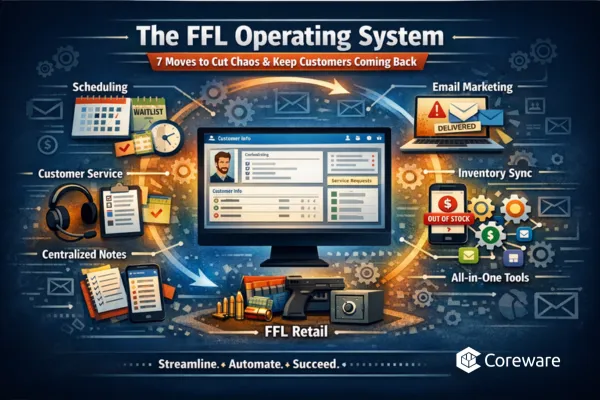
The FFL Operating System: 7 Moves That Cut Chaos, Save Time, and Keep Customers Coming Back
If you’re a gun store, you don’t need another “new idea.” You need fewer moving parts, fewer breakdowns, fewer handoffs, and fewer moments where the customer is waiting while your team is trying to figure out what’s going on.
Most shops aren’t struggling because they don’t work hard. They’re struggling because the work is happening in too many places at once. Notes in one spot. Scheduling in another. Customer requests in someone’s head. Email in a third tool. Website behavior doing weird things when inventory changes. The business runs, but it runs loud.
Here are seven moves that make a firearms retail operation tighter, cleaner, and more profitable. None of these are theory. They’re practical changes that stop the daily bleed.
1) Make “contacts” the center of your store, not the receipt printer
Every meaningful thing that happens in your business is tied to a person. Customer. Vendor. Employee. Lead. Gunsmith client. Training student.
If you don’t have one place where your team can quickly see the full story of that person, you are forcing your staff to guess. You’re also forcing your customers to repeat themselves, which is a fast track to losing trust.
The fix is simple: treat contact history like it matters. Track the touchpoints. Track the purchases. Track the service issues. Track the notes that should not disappear when one employee is off that day. When you get this right, your operation gets calmer immediately because “what’s going on?” becomes a 10-second answer instead of a scavenger hunt.
2) Build a real scheduling flow, not a “call us and we’ll see” habit
Scheduling is not just for ranges. If you do classes, gunsmith work, special consultations, or even “busy weekend counter time,” scheduling becomes a weapon. A good one.
The biggest overlooked power move is a waitlist system. Weekends get slammed, and customers who want real attention don’t want to hover at the counter hoping someone makes eye contact. A waitlist with a simple scan-in changes the whole vibe: customers feel taken care of, and your staff stops getting mobbed.
Same thing for classes. Registration, reminders, attendance, and follow-ups should be one connected process. If those live in separate places, it always turns into confusion the day of the event.
3) Treat customer service like an operating function, not an interruption
Customer service isn’t just phone calls. It’s “my transfer status.” It’s “my order problem.” It’s “my optic needs warranty handling.” It’s “my terminal is acting up.” It’s “my layaway question.” It’s “I need this repaired.”
When these requests live in random inboxes or someone’s memory, things slip. Customers get frustrated. Staff gets defensive. Your store gets louder.
The fix is to run service like an operations center: everything becomes a trackable request with ownership, status, and a paper trail. When done right, it also creates accountability without drama. You don’t need to “wonder” who’s handling something. You can see it.
4) Stop out-of-stock pricing from making you look shady online
This one is sneaky, and it costs trust.
A customer buys the last one in-store. They go home and look at your site and see the product still listed with a price that doesn’t match what they paid. Even if it’s out of stock, they don’t care. All they see is “Why is it cheaper online?”
This often happens when a website is pulling fallback pricing from another source, or showing old pricing for items that haven’t been in stock in forever. Either way, it creates a bad experience that you didn’t intend.
Your rule should be clear: if it’s out of stock, decide whether price should show at all. In a lot of cases, hiding price when something is unavailable reduces confusion and protects your reputation.
5) Email still works — but only if your emails actually hit the inbox
Email is still one of the most effective tools a retailer has because it’s direct. No algorithm. No “maybe they’ll see it.” If you do it right, you can drive foot traffic, fill classes, move slow inventory, promote new arrivals, and bring people back in without discounting your brains out.
But here’s the catch: modern email providers don’t play around anymore. If you’re sending bulk email without proper domain authentication, your message will get buried in spam or blocked outright.
That means you need your email sending setup to look legitimate to Gmail, Yahoo, and Microsoft. If you don’t know what that means, you’re not behind, you’re normal. Most retailers never had to think about it until the rules changed. The important part is this: deliverability is not optional anymore.
6) Put the “notes” where the work actually happens
This sounds small until you feel the difference.
Most stores have notes everywhere: a notebook, sticky notes, screenshots, texts, reminders, and “I’ll remember that.” That works until it doesn’t. Then someone forgets, someone quits, someone’s off, and the store pays the price.
Centralizing notes and making them shareable by role turns tribal knowledge into a real system. Store managers can run tasks and follow-ups. Training staff can keep class scripts and checklists. Marketing can keep campaign ideas. Gunsmith intake can be standardized. It’s not about having notes. It’s about making notes operational.
7) Reduce tool sprawl or you’ll keep paying for the same capability five times
This is the part retailers rarely add up.
One tool for customer service. One for scheduling. One for email. One for notes. One for contact tracking. One for website stuff. None of it talks to each other. You end up paying more, training more, and still living with gaps because data is fractured.
Even worse, when your tools are disconnected, you can’t build momentum. Every improvement becomes a new project, and every project becomes a new monthly bill. That’s how businesses get stuck doing busywork instead of doing business.
The win is to start consolidating workflows. Not in a way that shocks your team, but in a way that removes friction month by month.
The bottom line for FFL retailers
If your operation feels chaotic, it’s probably not because your staff doesn’t care. It’s because your systems aren’t built to support the speed and complexity of modern firearms retail.
Tight contacts. Clean scheduling. Real service workflows. Clear website rules. Inbox-ready email. Notes that don’t disappear. Fewer disconnected tools. Those aren’t “nice-to-haves.” That’s how you build a store that can scale without becoming miserable to run.
And one last note: these are exactly the kinds of capabilities we’ve been working toward at Coreware. Some are already live, and more are rolling out as we expand what retailers can do inside the platform. If you want to take a look, visit coreware.com.




Have Questions?
Get In Touch For Answers
Copyright 2022 Coreware -- All Rights Reserved